
 5.0

Holiday Claims Bureau (HCB) secured £2,000 for a passenger who suffered a head injury when a laptop fell from a bag that a cabin crew member was moving at an overhead locker. Her aeroplane accident claim concerned an incident on an easyJet return flight to the UK.
She completed the journey, but the effects continued after she arrived home. An A&E assessment documented concussion, and the injury disrupted household activities and her regular swimming before she recovered.
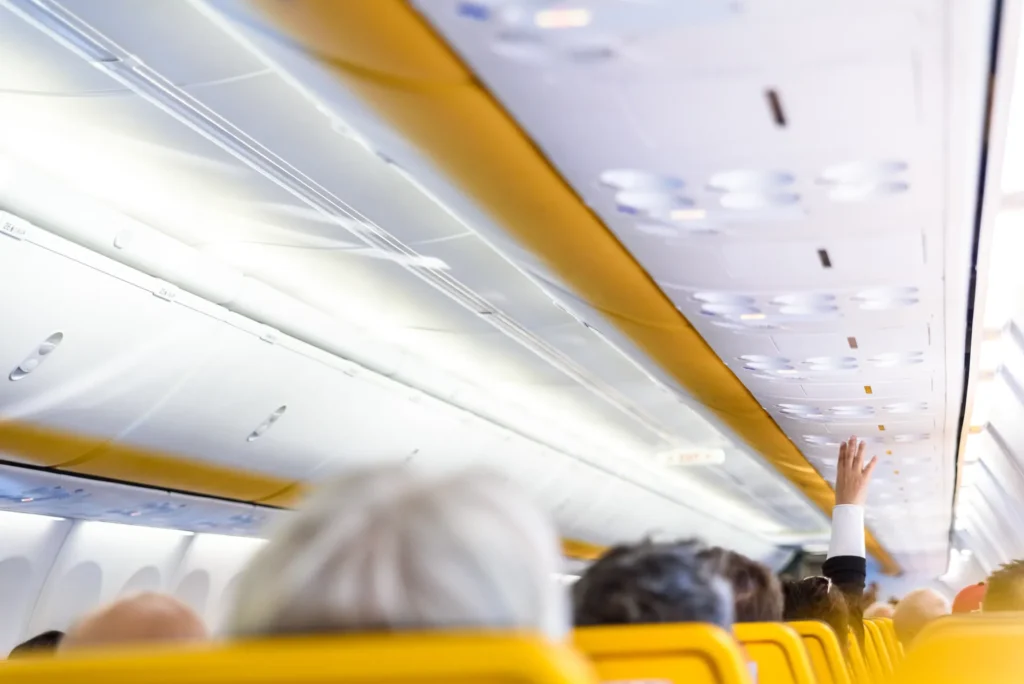
The client’s name and identifying personal details have been withheld. The cabin image is illustrative and does not show the aircraft or people involved.
A laptop fell as a bag was being moved
The client was sitting in an aisle seat before departure when a cabin crew member was moving a bag between overhead lockers. While the crew member was moving the bag, a heavy laptop fell out and struck the top of her head.
The impact was described as forceful enough to make her jaw close. She developed pain and a lump on her head, with a cut also described in the case documents.
According to the claim letter, the crew member brought an ice pack, recorded the incident on a tablet and checked on her during the flight. She remained on the aircraft and completed the journey, feeling nauseous and unusually tired.
Concern after she returned home
After the flight, her partner became concerned about how much she was sleeping. She attended A&E, where the records later reviewed by the medical expert documented a head injury and a diagnosis of concussion.
She was discharged with advice. In her later medical assessment, she recalled being advised to rest and described using pain relief while her symptoms were at their worst. She also mentioned the injury at a subsequent GP appointment arranged for another reason.
The symptoms she described included tenderness and swelling of the scalp, headaches, dizziness, nausea and light-headedness. She reported being particularly unwell for around a week, followed by gradual improvement.
How the injury affected everyday life
The independent medical report recorded the practical effects alongside the pain. She did very little housework for roughly ten days and mainly rested. She also stopped her regular swimming for around a month.
First week
The most significant symptoms, with pain, swelling and headaches affecting her recovery at home.
Around two weeks
She no longer needed regular pain relief. She had already become able to manage household tasks without further assistance.
Around one month
The remaining tenderness, swelling, headaches, dizziness and light-headedness had resolved.
During the later assessment by video, the expert found no visible evidence of residual injury. His report concluded that she had fully recovered and was not expected to have a lasting problem from the accident.
How Holiday Claims Bureau presented the case
Michael Walker set out the client’s account in a formal letter of claim to the airline. The letter alleged that the bag had been handled unsafely above a seated passenger and that its contents had not been adequately secured.
The claim relied on Article 17 of the Montreal Convention, which concerns passenger injuries caused by accidents on board aircraft or during boarding or disembarking. The airline formally admitted liability in May 2026.
HCB also instructed an independent medical report. The report brought together the client’s description of her recovery, an assessment by video and a review of her hospital and GP records.
A £2,000 settlement in September 2026
The case settled in September 2026 for £2,000. This was the total settlement before deduction of Holiday Claims Bureau’s success fee. The case involved an injury that eventually resolved, but still caused pain and disrupted normal activities for several weeks after the journey had ended.
For other injuries connected with a trip, our holiday accident claims page explains the wider types of case the team can assess.